Act I
The orange juice hit his medals first.
A bright, humiliating splash across polished brass, dark green wool, gold epaulettes, and the crisp red stripe of his formal trousers. The pitcher flipped from the silver tray, glasses shattered against the marble, and a wet burst of citrus spread across the officer’s chest before dripping down the front of his decorated uniform.
The banquet hall went silent.
Only a moment earlier, the room had been glowing with expensive calm. A crystal chandelier shimmered above white linen tables. Oil paintings in gold frames watched from the walls. Guests in evening dresses and dark suits lifted wineglasses beneath warm ambient light, speaking softly over polished silverware and folded napkins.
Then the young waitress slipped.
One wrong step on the polished floor.
One tray tilting too far.
One accident in a room full of people trained to treat accidents like moral failures when they happened to someone serving them.
Her name tag read Nora.
She was twenty-three, brown hair pulled into a tight professional bun, white button-down shirt tucked under a black server’s apron. Her face went pale with horror before the last glass stopped spinning on the floor.
“Oh my god,” she gasped, hands rising. “I am so incredibly sorry, sir! It was a complete accident!”
The officer stared down at his uniform.
Captain Adrian Vale was handsome in the sharp, public way that men in dress uniforms often become handsome before they become kind. Short blonde hair. Strong jaw. Dark green military jacket covered in service ribbons and medals. A man used to people straightening when he walked into a room.
For half a second, he looked stunned.
Then his face twisted.
“Look what you’ve done, idiot!”
The word cracked louder than the glass.
Nora shrank back, trembling. “Sir, I’ll get towels. I’m so sorry. We can—”
He stepped toward her and pointed one finger inches from her nose.
“Do you have any idea what this uniform means?”
A woman at the nearest table lowered her fork.
A man in a tuxedo leaned back, uncomfortable but not brave enough to stand.
Nora’s eyes searched the officer’s face for mercy and found none.
“I’ll pay for cleaning,” she said quickly. “Please, it was an accident.”
His mouth tightened into something colder than rage.
Then his hand moved.
The slap echoed through the banquet hall.
Nora’s head snapped to the side. One hand flew to her cheek. A guest gasped and covered her mouth. The room froze around the sound, every crystal glass and silver knife suddenly useless in the presence of violence.
Captain Vale stood over her, breathing hard.
Nora remained still.
At first, she looked shocked.
Then pain moved through her face.
Then something else.
She lowered her hand slowly.
Her cheek was red where his palm had landed. One tear slipped down the opposite side of her face, clean and visible in the chandelier light.
But her breathing changed.
Not panicked anymore.
Controlled.
In.
Out.
Her shoulders straightened.
Her feet shifted slightly on the juice-slick floor.
Captain Vale sneered.
“What, now you’re going to cry?”
Nora looked at him.
No one in the room saw the vulnerable waitress anymore.
They saw the moment something trained and buried woke behind her eyes.
He took one more step.
That was his mistake.
Nora moved faster than anyone expected.
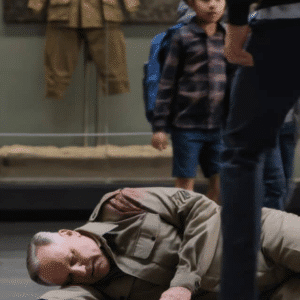
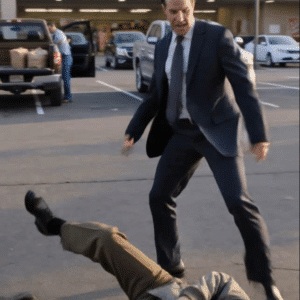
Her left hand caught his lapel. Her right hand found the back of his collar. She turned her hip, stepped through his balance, and used his own forward momentum against him. The larger man lifted off the floor with a shocked grunt, legs flashing upward as the chandelier light caught the red stripe on his trousers.
Then he hit the marble.
Hard enough to knock the air from him.
Broken glass skittered around his shoulders. Orange juice spread beneath his back. His medals clattered against his chest.
Nora dropped to one knee beside him, not on the glass, not reckless, but precise. She gripped his collar with both hands and leaned down until her face was inches from his.
The officer stared up at her, wide-eyed, gasping, suddenly very aware that rank meant nothing when a man could not breathe under the weight of his own arrogance.
Nora’s voice was low.
Quiet.
Dangerous.
“Never,” she said, each word cut clean, “ever hit a woman again.”
No one applauded.
No one moved.
The room simply stared as the man who had used his uniform like a weapon lay pinned in juice and glass by the waitress he thought was helpless.
And in that silence, someone near the back whispered the name that would turn humiliation into revelation.
“That’s Nora Reyes.”
Act II
Nora Reyes had spent years learning how to fall without staying down.
Her father taught her that.
Tommy “Ghost” Reyes was not famous enough for strangers to know him at dinner parties, but in certain gyms, in certain neighborhoods, his name still carried weight. He had been a boxer once, all angles and patience, the kind of fighter who could make larger men miss until they grew desperate. He taught Nora footwork before he taught her multiplication tables.
“Balance first,” he would say, tapping her sneakers with the end of a jump rope. “Power comes after. People who depend on power alone hate balance because they can’t steal it from you.”
Nora’s mother, Elena, hated watching them spar in the garage.
“She’s eight,” Elena would say.
Tommy would hold up both hands. “She’s learning discipline.”
“She’s learning how to throw her father into a lawn chair.”
Nora did that at eleven.
Tommy limped theatrically for three days and told every neighbor his daughter was a menace.
But the lessons changed after he died.
Not immediately.
The official story said Tommy Reyes died in a single-car crash on Route 19 after leaving a veteran charity fundraiser. The roads were wet. Visibility poor. No evidence of another vehicle. Tragic loss. Community mourns local boxing coach.
Nora was seventeen.
She remembered the funeral more by sounds than images.
Her mother’s breathing.
The priest’s shoes on stone.
The flag folded incorrectly by a volunteer who did not know Tommy had never served but had trained half the men who did.
And one man standing near the back of the church in dress uniform.
Adrian Vale.
Then a lieutenant.
He gave Elena a careful condolence and told Nora her father had been a good man who “sometimes involved himself in matters above his station.”
Nora had not understood the sentence then.
She understood tone.
Threat wears many uniforms.
Three months later, Elena lost the gym lease. A property company bought the building and raised rent by triple. Donors disappeared. Insurance claims stalled. Tommy’s old fighters scattered to other gyms. Elena took cleaning jobs. Nora deferred college. Life narrowed.
But Tommy had left her more than grief.
He had left notebooks.
Training journals at first glance. Footwork drills. Fighter weights. Bag routines. But between pages, written in shorthand Nora had to learn like a second language, were notes on something else: illegal fight rings, military-linked private security contracts, charity funds routed through shell companies, young veterans pushed into underground bouts under the promise of medical debt relief.
And one name repeated.
Vale.
Adrian Vale had not only been a military officer.
He had been the public face of Honor Bridge Foundation, a polished nonprofit raising money for wounded service members while quietly supplying fighters for private donor events. Men with brain injuries. Men with trauma. Men who owed medical bills. Men who thought fighting one more time might keep their families housed.
Tommy found out.
Tommy planned to expose it.
Tommy died.
Nora did not go to the police.
Not then.
She was a teenager with a dead father, an exhausted mother, and a file full of names men in power would call theories.
So she trained.
Boxing first.
Then judo.
Then restraint tactics, not the flashy kind people film in studios, but the ugly practical kind taught in women’s self-defense classes, veteran centers, and small gyms where instructors did not ask too many questions. She learned how to break grips, read weight shifts, use fabric, avoid blades, protect the head, keep witnesses alive.
She also worked.
Restaurants. Hotels. Banquet halls. Catering shifts where wealthy men laughed too loudly, drank too much, and assumed the people carrying trays were furniture with legs.
That was how she found Honor Bridge again.
A banquet.
A donor dinner.
Captain Adrian Vale scheduled as keynote speaker.
Nora recognized the name on the event sheet before she saw his face.
For three weeks, she tried to get removed from the shift. Then she stopped trying.
Because Mara Chen, the attorney who had quietly taken Tommy’s old files after Elena finally trusted her, said something Nora could not ignore.
“If Vale is there, people connected to Honor Bridge will be there too. Listen. Don’t confront him.”
Nora promised.
She meant it.
Mostly.
The orange juice spill was an accident.
The slap was not.
And when Adrian Vale’s hand struck her face in a room full of donors, Nora realized her father had been right about men who depend on power.
They hate balance.
Especially when it belongs to the person they hit.
Act III
“Get off me,” Captain Vale rasped.
Nora did not tighten her grip.
She did not need to.
That was what made the moment worse for him. She held him with technique, not rage. His uniform bunched under her fists. His medals pressed crookedly against his chest. He could feel every guest watching the collapse of the image he had spent years polishing.
Nora leaned closer.
“You’re going to stay still.”
“Do you know who I am?”
“Yes.”
That answer quieted him for half a breath.
The restaurant manager finally rushed forward, face gray with panic.
“Nora, let him go! Captain Vale, sir, we are so sorry—”
“Call security,” Vale snapped.
A man at the nearest table stood.
Another guest said, “He hit her.”
Vale turned his head sharply. “Stay out of this.”
Nora released his collar and stood, stepping back carefully from the broken glass.
Vale scrambled up, soaked and furious, one hand pressed to his ribs. His face had gone red, not from injury, but from public defeat.
“You assaulted an officer,” he said.
“You assaulted a waitress,” Nora replied.
His eyes narrowed.
The word waitress restored some of his confidence.
To him, it meant disposable.
He pointed at her.
“You’re finished.”
Nora touched her cheek once.
“No. I think you are.”
The banquet hall doors opened.
A woman in a dark suit entered with two investigators behind her. She moved with the kind of calm that made loud men look suddenly childish.
Mara Chen.
Vale’s face changed, barely, but Nora saw it.
Recognition.
Then calculation.
“Mara,” he said. “Interesting timing.”
She looked at the orange juice on his uniform, the broken glass, Nora’s red cheek, and the silent witnesses.
“Not as interesting as yours.”
The restaurant manager stammered, “I don’t understand—”
Mara held up a phone.
“Ms. Reyes was working tonight under legal observation related to an ongoing civil investigation into Honor Bridge Foundation. Several attendees at this dinner have been served preservation notices.”
The room stirred.
Nora saw men at two different tables glance toward one another.
Vale laughed.
It was a good laugh.
Confident.
Almost convincing.
“This is absurd. She spilled juice on me and attacked me.”
Mara turned to the guests.
“Did Captain Vale strike her first?”
Silence.
The old kind.
The cowardly kind.
Nora felt it settle over the room.
Then the woman who had gasped earlier stood, hands trembling.
“Yes,” she said. “He slapped her.”
Her husband tugged her sleeve.
She pulled away.
“He slapped her in front of all of us.”
Another guest stood.
“I saw it too.”
Then a server near the wall lifted her phone.
“I recorded it.”
Vale’s jaw locked.
Mara’s expression did not change.
“Good.”
Nora looked at the server.
The young woman’s eyes were wide, frightened, but steady.
That was how courage often arrived.
Not roaring.
Shaking and still speaking.
Vale stepped toward Mara.
“You have no authority here.”
One of the investigators moved between them.
“Captain Vale, we’re with the state attorney general’s office.”
The room changed again.
Not completely.
Power does not vanish when a badge appears. But it hesitates. It recalculates.
Mara opened a folder.
“Honor Bridge donor accounts. Shell vendors. Private event ledgers. Medical debt contracts signed by injured veterans. And now, assault in a room full of witnesses.”
Vale smiled thinly.
“You have no idea what you’re touching.”
Nora heard her father’s old warning in those words.
Matters above his station.
She stepped forward.
“My father did.”
Vale’s eyes flicked to her.
For the first time that night, he really looked.
Not at the uniform.
Not at the apron.
At her face.
The brown hair. The eyes. The stance.
The name tag.
Nora Reyes.
His expression shifted.
Just once.
“You,” he whispered.
Nora’s cheek still burned from his hand.
Her voice did not shake.
“Yes,” she said. “Me.”
Act IV
Captain Vale was not arrested in the banquet hall.
That would have been cleaner.
Dramatic.
Satisfying.
But powerful men often leave through side doors first.
The investigators served the notices. Witness statements were taken. The video of the slap was preserved before anyone could delete or “accidentally lose” it. Vale was escorted to a private room, where his attorney arrived before dessert would have been served.
Nora sat in the staff corridor with an ice pack against her face.
Her hands began shaking only after she was alone.
Mara found her there.
“You okay?”
“No.”
“Good. Honest answer.”
Nora laughed once, then winced.
Mara sat beside her on an overturned crate.
“You were supposed to listen, not throw him onto the floor.”
“He hit me.”
“I know.”
“I didn’t plan it.”
“I know that too.”
Nora looked down at her apron.
Orange juice had splattered the hem. Her white shirt was wrinkled. Her cheek throbbed. Somewhere beyond the swinging kitchen doors, rich guests were probably deciding whether the evening had been horrifying or merely memorable.
“Did he know my father?” Nora asked.
Mara was quiet.
That was answer enough.
“How much?”
Mara took out a folded document.
“Your father had a meeting scheduled with a federal investigator two days after he died. He was going to turn over evidence that Honor Bridge used debt coercion to force injured veterans into illegal fights for private donors. Adrian Vale’s signature appears on three vendor authorizations tied to those events.”
Nora closed her eyes.
“And his crash?”
“We reopened the file last month.”
Nora looked at her.
Mara’s voice softened.
“There was another vehicle.”
The corridor hummed with distant kitchen noise.
Metal pans.
Running water.
A cook cursing under his breath.
Nora felt suddenly far away from her own body.
“My mother?”
“She knows we suspected. She doesn’t know we have confirmation.”
Nora pressed the ice pack harder to her cheek.
For years, grief had been a locked room.
Now someone had opened a window and shown her the room had been built by men with names.
“What happens next?”
“Next,” Mara said, “Vale tries to discredit you. He’ll say you provoked him. He’ll say you assaulted him. He’ll say your father was unstable, that your family has a vendetta, that the investigation is politically motivated.”
“He already started.”
“Yes. And we’ll answer with evidence.”
Nora looked at her hands.
“My father used to say balance first.”
Mara nodded.
“Then keep yours.”
The story broke the next morning.
Not through a leak.
Through the server’s video.
By 8 a.m., everyone had seen the decorated officer slap a waitress, then hit the floor. Some watched for spectacle. Some cheered the throw. Some argued online about whether Nora had used excessive force. Some called her a hero. Some called her dangerous.
Nora hated all of it.
But the video did something evidence alone had struggled to do.
It made people look.
Within days, former Honor Bridge beneficiaries began contacting Mara. Veterans. Widows. Physical therapists. Former drivers. A hotel worker who remembered private boxing matches in a basement ballroom. A medic who had treated fighters off-book. A retired sergeant who had been pressured into signing debt agreements after surgery.
Then came the ledger.
It arrived in a padded envelope with no return address.
Inside was a flash drive and one handwritten note.
Tommy Reyes tried to stop them first.
The ledger named donors, fighters, payouts, injuries, and cover payments. It tied Honor Bridge to private security companies, shell medical charities, and one property firm that owned the road where Tommy’s car had been forced off the shoulder.
Adrian Vale was suspended.
Then charged.
Not only for assaulting Nora, though that charge mattered because the world had seen it.
For fraud.
Coercion.
Conspiracy.
Obstruction.
And eventually, after the crash investigation turned, involvement in a cover-up connected to Tommy Reyes’s death.
At the first hearing, Vale appeared in civilian clothes.
No medals.
No epaulettes.
No uniform to hide inside.
Nora sat behind Mara with her mother on one side and the server who filmed the slap on the other.
Vale avoided looking at her.
That suited Nora fine.
The room did not need his eyes.
It had his signature.
Act V
Nora did not become famous the way strangers wanted her to.
She refused interviews that asked her to reenact the throw. She declined morning shows that wanted to call her “the waitress who took down a soldier.” She corrected anyone who described Captain Vale as a soldier first.
“He was a man who hit someone he thought couldn’t hit back,” she said once. “Start there.”
Her mother, Elena, watched that clip three times.
Then cried at the kitchen table.
Not because of the words.
Because Nora sounded like Tommy.
The trials took time.
They always do when power has money.
Adrian Vale’s legal team tried to separate the slap from the foundation, the foundation from the illegal fights, the fights from the crash, the crash from the men who benefited from Tommy Reyes’s silence. Mara spent months stitching what they tried to tear apart.
Witness by witness.
Bank record by bank record.
Medical invoice by medical invoice.
At one point, Vale’s attorney asked Nora whether she had enjoyed humiliating his client.
Nora looked at the jury.
“No,” she said. “I enjoyed surviving him.”
The courtroom went still.
Later, when the verdicts came, they did not heal everything.
Vale was convicted on multiple counts tied to fraud, assault, coercion, and obstruction. Two associates took plea deals. A former foundation accountant testified. The crash case remained more complicated, with charges against others still moving through the courts, but the official record finally changed.
Tommy Reyes had not simply lost control of his car.
He had been targeted after uncovering a criminal operation.
Elena visited his grave with the amended report folded in her purse.
Nora went with her.
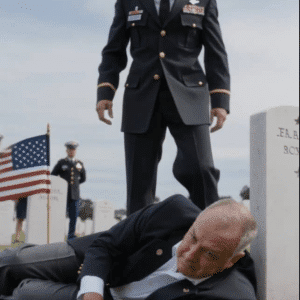
They stood under a gray sky in the cemetery where Tommy’s headstone had carried an incomplete truth for six years.
Elena touched the carved name.
“They made me feel crazy,” she whispered.
Nora took her hand.
“You weren’t.”
“I knew he wouldn’t drive like that in rain. Your father hated wet roads.”
“I know.”
“He used to say tires tell the truth before people do.”
Nora smiled through tears.
“He said that about everything.”
Elena opened her purse and pulled out the old silver chain Tommy wore when he trained. Hanging from it was a small charm shaped like a boxing glove, worn smooth from years against his chest.
“He would want you to have this.”
Nora closed her fingers around it.
For the first time since the banquet, she cried without anger carrying half the weight.
The fine-dining restaurant fired her the night of the incident.
Then tried to quietly offer her job back after public pressure.
Nora declined.
So did seven other servers, including the young woman who filmed the slap.
Together, with settlement money and help from Mara’s network, they started a hospitality worker defense fund named The Balance Fund. It offered legal aid, emergency grants, self-defense training, and employer accountability support for service workers facing abuse from customers or managers.
The first training was held in an old community center gym.
Nora stood in front of twenty women and three men, all in sneakers, all nervous.
She held up her hands.
“This isn’t about learning how to hurt people,” she said. “It’s about learning that your body belongs to you even when you’re being paid to serve someone.”
A woman in the front row began crying before the first drill.
Nora understood.
The body remembers every time it was told to stay polite through fear.
She taught them balance first.
Always balance.
Years later, the banquet hall still had chandeliers and white linens. Rich people still gathered beneath oil paintings, still complained about sauces, still believed money gave them the right to speak sharply. But in kitchens and staff corridors across the city, a story traveled.
A waitress spilled orange juice.
A decorated man hit her.
She put him on the floor.
Then the truth came out.
People told it with different details. Some exaggerated the throw. Some said she broke his arm, which she did not. Some said she had planned the whole thing, which she had not. Some missed the point entirely and turned violence into entertainment.
Nora knew the real story was quieter.
It was about her father’s notebooks.
Her mother’s grief.
Mara’s evidence.
A server brave enough to press record.
A room full of guests learning that silence has witnesses too.
And a slap that revealed not one man’s temper, but an entire system that had mistaken uniforms, money, and titles for permission.
On the fifth anniversary of Vale’s conviction, Nora returned to the old gym where Tommy had trained her.
The heavy bags still hung from iron chains. The floor still smelled like sweat and leather. Golden light poured through high windows and caught dust in the air, the same way it had when she was a child learning to shift her feet.
Nora placed her father’s boxing glove charm on the edge of the ring.
Then she wrapped her hands.
Elena watched from a folding chair.
“You don’t have to keep fighting,” her mother said.
Nora tightened the wrap around her wrist.
“I know.”
“Do you believe that?”
Nora looked at the ring.
At the ropes.
At the space where Tommy once stood with a towel over his shoulder, telling her not to lean too far forward because anger makes people easy to tip.
“Yes,” she said. “Now I do.”
She stepped into the ring alone.
No opponent.
No crowd.
No chandelier.
Just her breath and the old lesson.
Balance first.
She moved slowly at the beginning. A step. A pivot. A turn of the hip. Her body remembered what fear had tried to distort. Not violence. Not revenge. Control. Ground. Choice.
At the end, she stood in the center of the ring and touched the cheek where Adrian Vale had struck her years before.
There was no mark now.
But she did not need one.
Some scars become law.
Some become funds.
Some become warnings passed from worker to worker in break rooms, kitchens, banquet halls, and hotel corridors.
Some become a woman standing tall after the world expected her to apologize for bleeding.
Nora looked toward her mother.
Elena smiled.
Tommy’s charm caught the light.
And for the first time, Nora understood that her father had not trained her to win fights.
He had trained her to know the difference between falling and being put down.
The officer had slapped a waitress because he thought the room would protect him.
Instead, the floor told the truth.
And Nora Reyes made sure everyone heard it.